
Article Summary
- AI adoption is accelerating faster than traditional security models can handle, creating new risks tied to data volume, speed, and visibility.
- Generative AI security risks are expanding the attack surface, especially at the edge where endpoints and AI-generated internal tools operate.
- Fortinet Security Fabric provides a unified, high-performance approach to AI security, enabling real-time protection across network, cloud, and endpoint environments.
AI Is a Data Multiplier, Not Just a Tool
AI is often framed as a productivity driver, but in practice, it functions as a data multiplier.
Every AI interaction generates:
- Inputs from users
- Outputs from models
- Logs, embeddings, and stored context
This constant flow reshapes where and how data exists. Many teams are replacing SaaS tools with AI-generated internal tools, shifting sensitive data into new and often unmonitored environments.
The result is a sharp increase in endpoints and a drop in visibility. Imagine every employee operating their own AI tool. Each one becomes a new point of access, a new data source, and a potential vulnerability.
This is where many Generative AI security risks strategies fall short. They focus on the tool, not the data ecosystem surrounding it.
The Expanding Attack Surface
As AI adoption grows, so does the attack surface.
More endpoints mean more opportunities for compromise. Less visibility means threats can move undetected. According to recent data, edge devices now account for a significant portion of initial compromises in SMB environments (source)
AI-driven environments amplify this risk. Data is constantly moving between endpoints, cloud systems, and internal tools. Without unified oversight, security teams are left reacting instead of preventing.
Understanding Shadow AI Threats
One of the fastest-growing risks in AI security is the rise of Shadow AI.
Teams are building and deploying AI-generated internal tools using open-source models and APIs. These tools often bypass formal security review in the interest of speed and innovation.
While the intent is productivity, the outcome can be exposure.
Common Shadow AI threats include:
- Sensitive data leakage through unsecured prompts or outputs
- Unprotected APIs that can be exploited
- Lack of access control across internal AI systems
These risks directly impact AI data privacy. Without governance, organizations lose track of where their data lives and who can access it.
Why Traditional Security Models Break
Legacy security models were built for a different era. They assume predictable traffic patterns, centralized data, and clearly defined perimeters.
AI breaks all of those assumptions.
Cloud-only security introduces latency and gaps in real-time inspection. AI workloads require real-time analysis and high-performance processing.
At the same time, siloed tools create blind spots. Each system may perform well on its own, but without integration, they fail to provide a complete picture.
Why Security Must Move to the Edge
AI workloads are not confined to a single location. They exist at endpoints, within on-prem systems, and across hybrid cloud environments.
This makes edge security essential.
By moving security closer to where data is created and processed, organizations can:
- Enable real-time inspection of AI activity
- Reduce latency for faster response
- Stop threats before they spread across the network
Edge environments are now a primary battleground for AI security. If they are not protected, the rest of the infrastructure becomes vulnerable.
Organizations can strengthen their approach by investing in strong network security that provides visibility and control at the device level.
The Case for Converged Security
Adding more tools is not the answer. In fact, it often makes the problem worse.
AI scale requires coordination, not fragmentation.
A converged security approach integrates key capabilities into a unified framework, including:
- Intrusion Prevention Systems (IPS)
- Next-Generation Firewalls (NGFW)
- Anti-malware protection
- Data Loss Prevention (DLP)
- Network Access Control (NAC)
- Endpoint Detection and Response (EDR)
- SSL inspection
When these systems operate together, organizations gain a clear, real-time view of their environment. This is critical for managing Generative AI top security considerations effectively.
For organizations exploring modern architectures, solutions like FortiSASE help extend this unified approach across distributed environments.
Where Fortinet Security Fabric Fits
This is where Fortinet Security Fabric stands apart.
It connects security across network, endpoint, and cloud into a single, coordinated system.
Key advantages include:
- Real-time visibility across all traffic, including encrypted data
- High-performance processing designed for large data volumes
- Integrated security capabilities that reduce operational gaps
Solutions like FortiGate provide advanced firewall protection, while FortiSASE extends security to remote and hybrid users. Together, they create a consistent security posture across the entire organization.
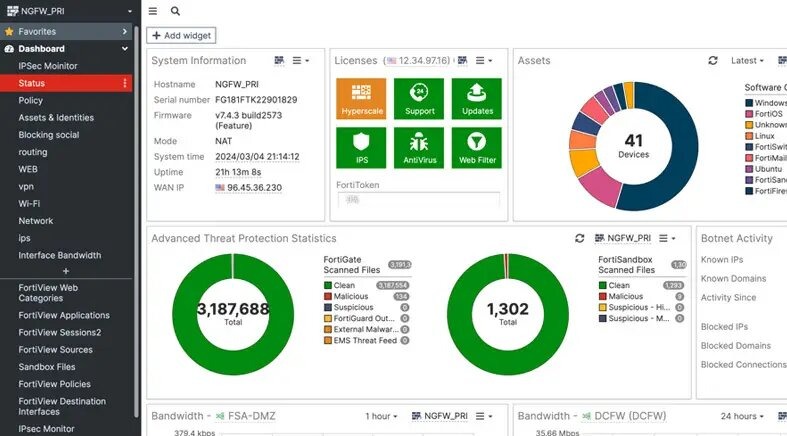
For teams looking to unify control, FortiSASE integration plays a critical role in connecting endpoint, network, and cloud security.
The result is fewer blind spots and stronger protection against AI-driven threats.
Key Questions Every Organization Should Ask
To strengthen AI security, leaders need to ask better questions:
- Where is AI-generated data stored?
- Who has access to that data?
- Is it being actively monitored?
- How quickly can threats be detected and contained?
Without clear answers, risk continues to grow. Ongoing cybersecurity monitoring is critical for maintaining visibility and responding to threats in real time.
Final Thoughts: Securing the AI Era
AI is transforming how businesses operate, but it is also redefining the threat landscape.
The combination of increased data, expanded endpoints, and rapid deployment creates a new level of complexity. Traditional approaches cannot keep up.
Fortinet Security Fabric offers a path forward. By unifying security across environments and moving protection closer to the edge, it enables organizations to scale AI without sacrificing control.
For companies ready to take AI security seriously, the next step is clear. Build a strategy that matches the speed of innovation, not one that lags behind it.