
Article Summary
- OT/IT convergence isn’t just a technology shift; it’s a leadership responsibility shift, and most executive teams aren’t equipped for it.
- The majority of organizations are defaulting into “IT Takeover” mode without realizing it, applying IT frameworks to OT environments that operate by completely different rules.
- The only model that actually works is an integrated team approach, with clearly defined ownership, cross-functional accountability, and partners who understand both sides of the equation.
The biggest obstacle in OT/IT convergence is not technology. It is a conversation that never happened.
When IT leadership takes ownership of operational technology environments, the technical challenges are real: legacy systems, industrial protocols, and infrastructure that was never designed with cybersecurity in mind. But the failures that cause the most damage, the ones that trigger safety incidents, unplanned downtime, and missed compliance requirements, rarely trace back to the wrong tool. They trace back to teams that were never brought into the same room.
IT and OT have operated in separate worlds for decades, each with its own language, its own priorities, and its own definition of what a successful day looks like. Convergence does not eliminate that gap. It requires leaders who can bridge it deliberately, before standards are enforced, before frameworks are deployed, and before the first conflict between uptime and security lands on someone’s desk without a clear answer.
Eighty percent of organizations are now placing OT under the oversight of CIOs and CISOs. That shift is happening fast, with limited preparation, and often without the cross-functional alignment that makes it sustainable. If your organization is in that majority, the question is not whether you own OT. It is whether your teams are ready to own it together.
Why IT/OT Convergence Is First a Leadership Challenge
IT leaders bring real strengths to this transition: standardization, centralization, and security-first thinking are exactly what maturing OT environments need. The challenge is not that IT is wrong. It is that OT environments operate by a different set of rules, and those rules do not bend to accommodate IT timelines.
In operational technology environments, uptime is not a performance metric. It is a safety and revenue requirement. A manufacturing line that goes down during a security patch cycle does not just create an IT incident. It creates a production loss, a potential safety event, and in some cases a contractual or regulatory failure. Legacy systems in OT are not technical debt waiting to be cleared. They are load-bearing infrastructure that keeps physical operations running, often in environments where a replacement cycle is measured in years, not quarters.
Ask before your next OT decision: Have you interviewed OT stakeholders, including operators, plant managers, and safety officers, to understand what “healthy” actually looks like in their environment? Who owns uptime? Who owns security? What happens when those two priorities collide?
When these conversations do not happen before implementation, the consequences are not hypothetical. They show up as:
- Safety risks introduced by security changes that were not evaluated against operational protocols
- Revenue-impacting downtime triggered by patches, policy enforcement, or network changes applied without OT context
- Missed OT security requirements because IT frameworks were applied without accounting for industrial protocol differences
- Accountability gaps when an incident falls between IT and OT ownership with no clear decision-maker
None of these outcomes are the result of bad intentions. They are the result of a communication gap that was never closed before implementation began.
The Four Models Companies Use, and Why Three of Them Fail
Most organizations do not choose their convergence model deliberately. They drift into one based on which team has the mandate and the momentum. Understanding these patterns is the first step toward choosing differently.
- Build a Wall: IT and OT remain siloed. No shared visibility, no shared responsibility. Feels safe in the short term. Creates dangerous blind spots as threats evolve and environments become more connected.
- IT Takeover: IT enforces its standards across OT with minimal input from OT teams. This is the most common default, and the most disruptive. Organizations often do not realize they are in this model until something breaks, and by then the friction between teams can be as damaging as the technical problem itself.
- Chaos Model: Neither side has clear ownership during the transition. Decisions get made reactively. Accountability is diffuse. This model is most common during leadership transitions or rapid organizational change.
- Integrated Team: IT and OT leaders define shared accountability before enforcing any standards. Security and uptime priorities are negotiated, not assumed. Ownership is explicit. This is the only model that creates sustainable convergence without sacrificing either security posture or operational continuity.
The integrated model does not happen by default. It requires deliberate design, executive sponsorship, and usually, outside guidance from partners who have navigated this transition across multiple environments and can help both sides find common ground.
What Organizations Should Actually Do Before Standardizing Anything
Convergence done right starts with alignment, not implementation. The organizations that get this transition right are the ones that invest in building the shared understanding before they build the shared infrastructure.
Assess the network, the controls, and discuss the consequences before enforcing anything. If you cannot answer “what breaks if we enforce this?” you are not ready to enforce it.
Before applying any IT security framework to your OT environment, the groundwork looks like this:
- Educate IT leadership on OT realities: what uptime means in an industrial context, how legacy systems function within physical operations, and why safety decisions must be evaluated before, not after, security changes
- Build joint accountability before enforcing standards: bring OT leaders into security planning as co-owners, not just stakeholders whose sign-off is collected after decisions are made
- Define ownership explicitly before the first conflict arises: who owns uptime, who owns security, and who makes the final call when those two priorities are in tension
- Map your OT network, evaluate your current controls, and document the operational consequences of every major security change before rollout, so that enforcement decisions are made with full visibility into what they affect
This work is not a delay to convergence. It is the foundation that makes convergence last.
Why Liquid Networx and Fortinet Are Built for This Moment
The gap between IT and OT is not just a technology problem. It is a people and process problem, and solving it requires partners who understand both sides of the equation well enough to translate between them.
Fortinet’s Enterprise OT and IoT Security platform, including FortiGuard OT threat intelligence, is purpose-built for environments where IT frameworks are not enough. It treats OT as a distinct environment with distinct requirements, providing visibility, segmentation, and detection capabilities designed for industrial protocols and legacy systems rather than retrofitted from enterprise IT security tools.
Liquid Networx brings the implementation and collaboration layer. As a network services provider with real-world experience across both IT and OT environments, the Liquid Networx team helps organizations build the governance model before deploying the technology. That means facilitating the conversations between IT and OT leadership, designing the accountability structure that prevents ownership gaps, assessing the current environment with an understanding of operational consequences, and deploying solutions that bridge both worlds without forcing one to become the other.
The complexity of this transition is exactly why it requires more than a platform. It requires a partner who can sit with both teams, speak both languages, and help them arrive at a shared definition of success before any standards are enforced.
Liquid Networx brings the implementation layer. As a network services provider, our team helps organizations design the governance model, assess the environment, and deploy solutions that bridge IT and OT without forcing one to become the other.
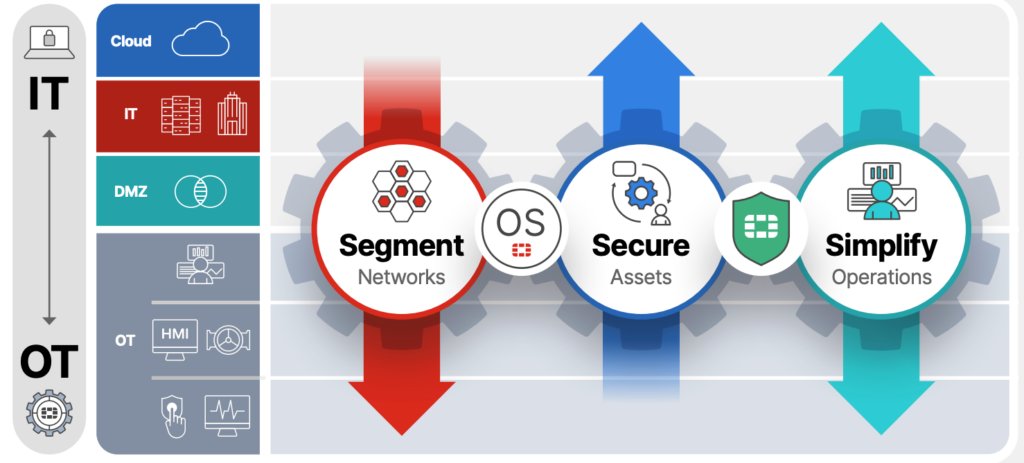
Image credit: Fortinet Operational Technology
OT SOC vs. IT SOC: Understanding the Difference
A traditional IT SOC monitors network traffic, endpoints, and cloud infrastructure for threats, and is optimized for rapid patching, containment, and recovery.
An OT SOC monitors industrial control systems, SCADA environments, and operational assets, and is optimized for threat visibility that does not interfere with physical operations. In an OT context, the priority is not speed of response. It is safety of response.
Liquid Networx operates SOC capabilities designed to bridge these two worlds, so your security posture does not require choosing between protecting your data and keeping your operations running. That is not a technical compromise. It is the outcome of building a convergence strategy where both sides of the equation are understood from the start.
Ready to build a convergence strategy that actually works? Talk to the Liquid Networx team about how we partner with Fortinet to help you align IT and OT without sacrificing uptime or security.Liquid Networx operates SOC capabilities designed to bridge these two worlds, so your security posture doesn’t require choosing between protecting your data and keeping your operations running.